
A Queensland mining industry watchdog has issued a safety alert highlighting recent court findings on operating machinery such as bulldozers and dump trucks during lightning storms.
The Industrial Court decision came down in favour of Resources Safety and Health Queensland (RSHQ) regarding directives issued to BHP Mitsubishi Alliance in October 2023.
The BMA Peak Downs mine had been continuing to operate heavy vehicles when lightning strikes were less than 16km away, arguing that its precaution of having tyres filled with 95 per cent nitrogen prevented them from exploding if struck.
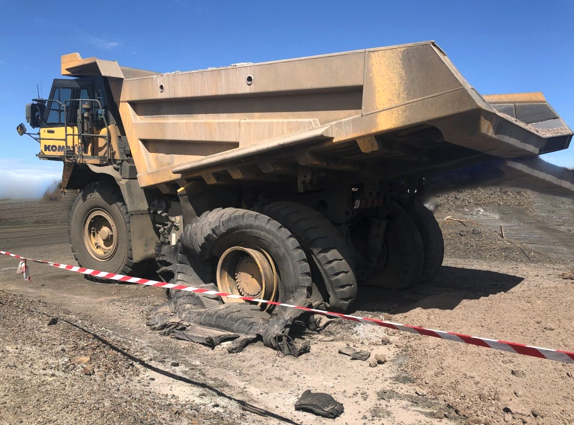
Image at top of page: A dump truck tyre that exploded following a lightning strike.
RSHQ Chief Inspector of Coal Mines Jacques le Roux said that while this was true, he had issued a directive to stop operations on the basis that other factors associated with lightning events still presented an unacceptable level of risk to workers.
He said subsequent court proceedings had helped provide a clearer direction to surface mines when it came to the risks in operating heavy mobile equipment (HME) during severe lighting.
The Industrial Court made the following findings:
- There is a risk that if HME is operated during nearby lightning events and the tyres are not filled with 95 per cent nitrogen, then the tyres could explode, endangering workers.
- Filling tyres with nitrogen might address one risk (tyre explosions) but not all risks.
- The safety of workers operating HME during nearby lightning events may reach an unacceptable level of risk resulting in the injury or death of workers.
- HMEs have a ‘Faraday cage’ effect so that the energy of a lightning strike would be dispersed across the surface if it were to be hit. However, this only gives partial protection and there are still metal surfaces (like pedals) inside the HME that can conduct electricity in the event of a lightning strike.
- When lightning strikes are occurring within 16km, HME with nitrogen-filled tyres must be safely parked up and workers should stay in the vehicles until lightning has abated.
Mr le Roux said RSHQ still encouraged workers to leave vehicles and move to a safe building before lightning got close, whether tyres were filled with nitrogen or not.
“The safest place for workers to be during a lightning event is in a secure building with lightning protection,” he said.
“However, the court has deemed it is safe enough for workers to stay inside heavy mobile equipment if tyres are nitrogen filled but, importantly, they must park up in a safe location and not operate when lightning is within 16km.
“It’s commendable BMA is looking at ways to improve safety, such as filling tyres with nitrogen, and we encourage other open-cut mine operators to do the same. We wouldn’t be doing our job as a regulator if we weren’t pushing for the safest possible option.”
Mr le Roux said the court outcomes also confirmed open-cut mine workers should never be in heavy mobile equipment without nitrogen-filled tyres if lightning was within 16km.
“Mines that do not operate HME with nitrogen in their tyres should transition workers to a safe building before lightning approaches the site,” he said.
“Mines with nitrogen-filled tyres must ensure there are adequate processes in place to ensure the tyres stay at 95 per cent nitrogen or more. Anything less could cause an explosion in the event of a lightning strike.”
The most recent lighting event causing injury in Australia occurred in Western Australia in January where six workers needed medical treatment after a lightning strike caused a tyre explosion in a dump truck.